

Information for Participants
This page provides you with more information on what the POINTER-PC trial involves, including the three trial treatments.
There is a diagram below illustrates the different treatments you could be selected to received when you participate in the trial.
Listed below the diagram are some questions you may have, when you click on a question, below this an animated video will appear for you to watch and it will provide an answer to the question. In addition, if you prefer to read the answer a transcript of the video instead this is provided below the video. If there are any questions you have that are not answered here, your nurse or doctor will be able to answer these.
Overview of the POINTER-PC trial treatments
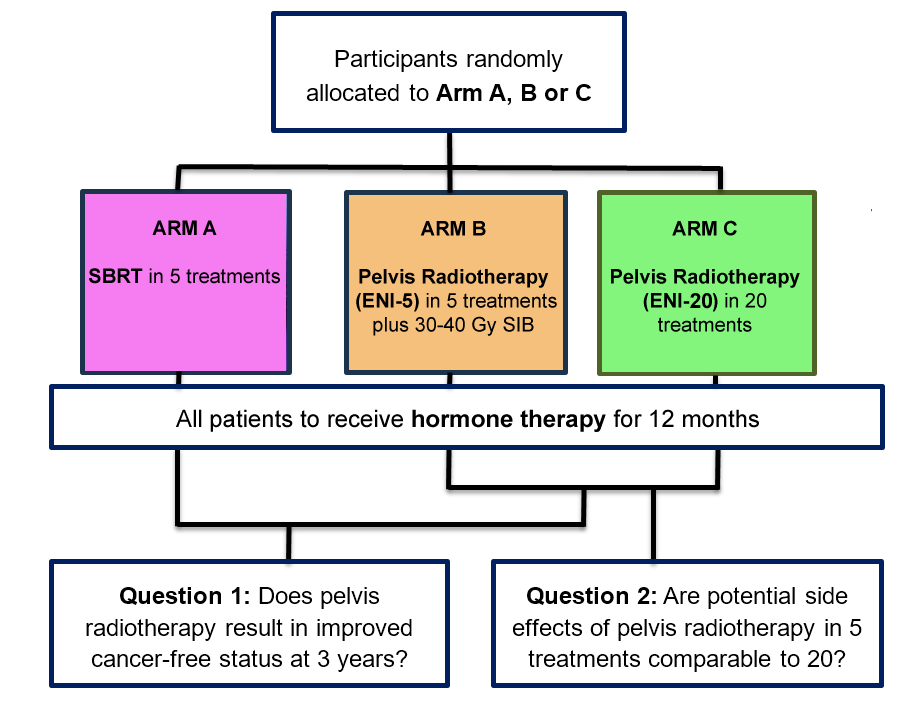
Doctor: The POINTER-PC trial is focused on treating patients whose Prostate Cancer has returned or “recurred” after a period of remission or successful treatment. The trial has 3 arms with 3 possible treatments to deal with this. If you choose to take part, you will be randomly assigned to one of these arms. These are explained further below.
Doctor: After previous treatment, prostate cancer can come back (i.e. recur) in glands (known as lymph nodes) in the pelvis. When this happens, there are different treatments that could be used to treat the cancer, but we do not know for certain which treatment is best. Two different types of radiotherapy could be used. The glands could be treated with focused radiotherapy given in a small number of treatments (typically 5), which is called stereotactic body radiotherapy (SBRT). Alternatively, both the surrounding pelvis and the glands could be treated with radiotherapy, which is known as pelvis radiotherapy or extended nodal irradiation (ENI). POINTER-PC’s main goal will compare pelvis radiotherapy with SBRT to see which is better at stopping the cancer from coming back again.
Doctor: If you agree to be on the trial, you will be allocated to one of the arms of the POINTER-PC via a randomised ratio of 2:1:1. This means that 2 out of every 4 patients will receive SBRT, 1 in 4 will receive ENI-5 and the last 1 in 4 will receive ENI-20. A computer will randomly assign your treatment, like the roll of a dice.
Doctor: All participants will also receive 12 months of hormone therapy starting up to 4 weeks before radiotherapy starts. This will be given in the form of a tablet.
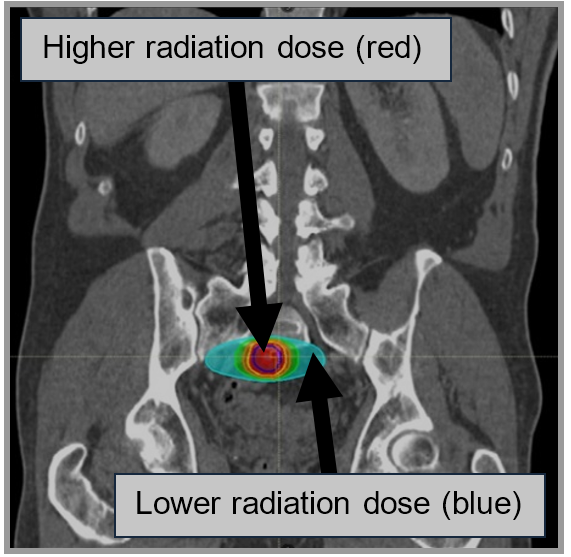
Doctor: If randomised to Arm A your treatment will be Stereotactic Body Radiotherapy (SBRT), this is a type of radiotherapy which uses special equipment to precisely deliver a dose of radiation to your tumour. This will be delivered in 5 sessions every other day over 2 weeks, Monday to Friday with weekends free.
This image (focused on the pelvis area) shows how the radiation for Arm A is focused with the biggest concentration received in the centre in red, steadily decreasing into the light blue areas.
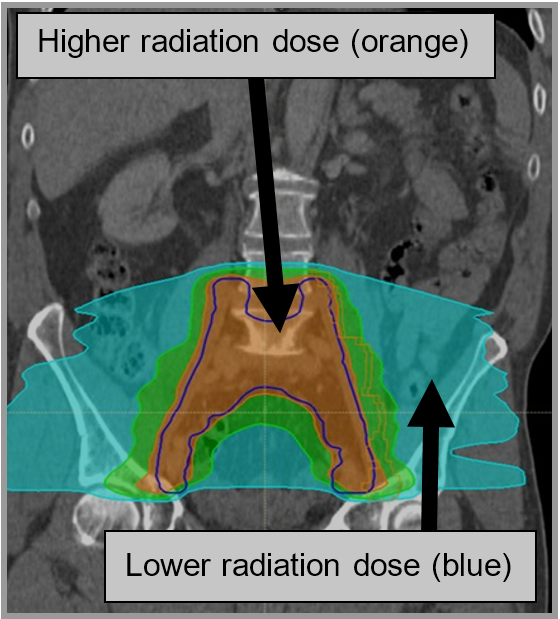
Doctor: On Arm B you would receive Extended Nodal Irradiation (ENI-5) treatment with 5 sessions, every other day over 2 weeks. This is a treatment where the surrounding areas such as the pelvis as well as the cancerous glands are targeted with the radiotherapy.
Here (in the pelvis) you can see where the highest dose is received, shown in orange, with the dose decreasing further out with the lowest received in the area highlighted in blue.
Doctor: On Arm C you would Receive 20 treatments of Extended Nodal Irradiation (ENI-20) every weekday for 4 weeks. This is a treatment where the surrounding areas such as the pelvis as well as the cancerous glands are targeted with the radiotherapy.
Here (in the pelvis) you can see where the highest dose is received, shown in orange, with the dose decreasing further out with the lowest received in the area highlighted in blue.
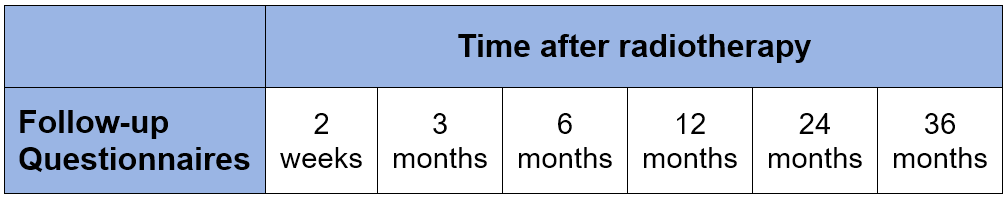
Doctor: At the beginning of your treatment, we would like you to complete 2 questionnaires on your quality. We would also like you to complete these on your follow up appointments at 2 weeks, 3, 6, 12, 24 and 36 months to record any changes felt. Your research nurse will provide the questionnaires for completion.
These can be completed on either the electronic data entry system or on a paper form. The link to the electronic system can be found under the questionnaires tab of the website. If you choose the electronic option, you will receive links via either SMS or email, depending on your preference.
Doctor: We will keep checking that you are OK during the study and will carry out regular clinical assessments. We will also ask how well you are or if you are having any side effects during your treatment to monitor your progress.
We would like to continue to monitor your progress once your treatment has ended, so we will arrange an appointment either in person or by telephone for you with your research nurse 2 weeks after you finish your radiotherapy. From then on you will have regular follow up appointments at the hospital with your doctor at 3, 6, 12, 18, 24, 30 and 36 months following your treatment.

This table can be printed as part of the key facts sheet.
As a publicly funded organisation, we make sure that using personal information from people who participate in research is in the best interest of the public. When you agree to be part of a research study, we use your data for the study’s purposes, like analysing the results. If you want more details or have questions, check your Patient Information Sheet or ask your nurse or doctor.
Further Details
For more information about the trial and your participation, relevant documents can be found here.