
Trial Summary
Where is POLARiS taking place?
At least 20 hospitals across the UK will be taking part, recruiting from September 2023 to March 2026. There are also some hospitals in Australia taking part.
What is the cohort study?
The cohort will explore the history of Low Anterior Resection Syndrome (LARS) and quality of life in patients who have undergone a colorectal resection for cancer in the last 10 years. The cohort will also identify suitable patients for the randomised controlled trial.
What is the randomised controlled study?
The Randomised controlled trial (RCT) will look at clinical and cost effectiveness of Transanal irrigation (TAI) or Sacral neuromodulation (SNM) versus optimised conservative management (OCM) for people identified as having major LARS symptoms.
The qualitative sub-study will involve interviews with some participants who consent. This is to find out what you thought about your symptoms and treatments.
What is Lower Anterior Resection Syndrome (LARS)?
Rectal Cancer Surgery can result in bowel symptoms which collectively are called Low Anterior Resection Syndrome or LARS. LARS symptoms include
- going to the toilet multiple times (frequency)
- having to rush to the toilet (urgency), being unable to control your bowels (incontinence)
- going to the toilet several times in a short period (clustering)
- feeling that you are unable to fully empty your bowels (obstructed defaecation)
- unpredictable bowel habits
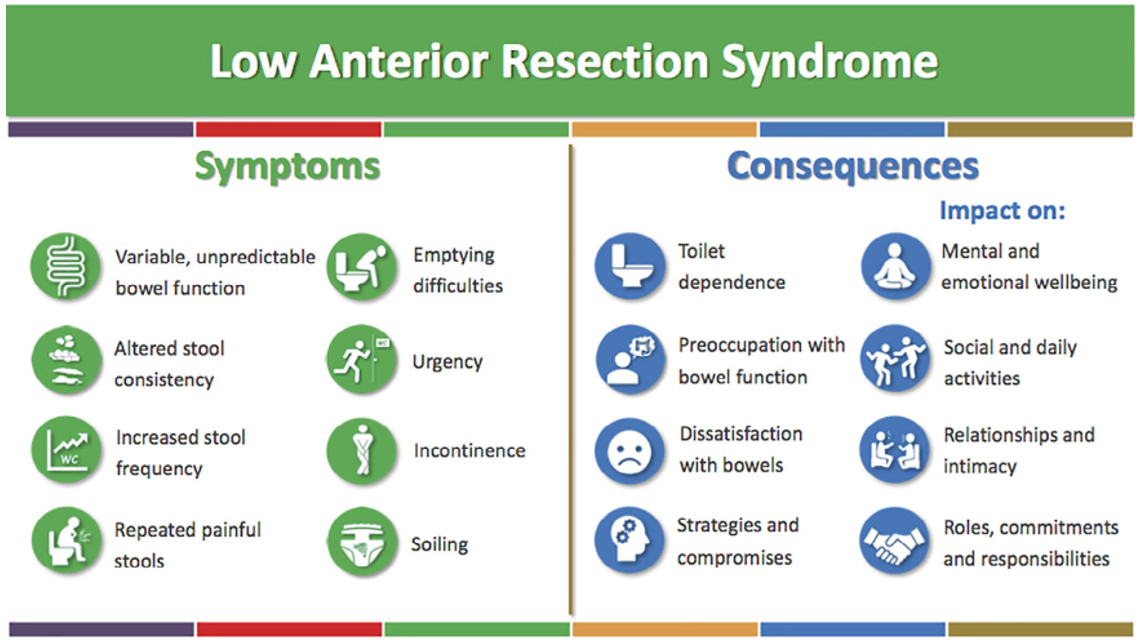
Low Anterior Resection Syndrome (Keane et al. 2020) © 2020 The Author(s). Published by Wolters Kluwer Health, Inc. on behalf of the American Society of Colon and Rectal Surgeons, by John Wiley & Sons Limited on behalf of the Association of Coloproctology of Great Britain and Ireland and by John Wiley & Sons Australia on behalf of the Royal Australasian College of Surgeons. This is an open access article distributed under the terms of the Creative Commons Attribution-Non Commercial-No Derivatives License 4.0 (CCBY-NC-ND), where it is permissible to download and share the work provided it is properly cited. The work cannot be changed in anyway or used commercially without permission from the journal.