
FAQ
About 6,000 people in the UK are diagnosed with myeloma each year. Around 1 in 5 people with myeloma take part in clinical trials to help test new treatments. The BLISS project will bring together information from our completed myeloma clinical trials with NHS England’s Healthcare Systems Data (HSD). We are only using data from trials that have already finished. By linking these datasets, we can answer important research questions about myeloma more quickly.
If you are the carer or relative of someone who previously took part in one of the clinical trials listed, you may be able to support them in understanding the aims of the BLISS project and what it involves.
- It will lead to better outcomes for myeloma patients and help us to understand if we are approaching a cure for people with myeloma.
- It aims to provide a more efficient way for us to follow up our clinical trial patients over the long term. We hope that this will reduce the number of study visits needed for patients taking part in a clinical trial.
- It will also help us understand barriers to inclusive research and enable us to improve future clinical trials.
We have involved patient representatives in the development of the BLISS project from the very beginning. Listening to their experiences helps us better understand what matters most to people living with myeloma and other blood cancers. There are currently eight patient representatives involved in the project. You can find out more in the Patient and Public Involvement section of this website.
Data linkage means bringing together information from different places to one central place.
In the BLISS project, the data we hold on people who took part in our myeloma trials will be combined with some routine NHS information held about them.
The data linkage will enable BLISS researchers to build a fuller picture of the health of people who took part in our trials and how well the treatment for myeloma worked over the longer-term.
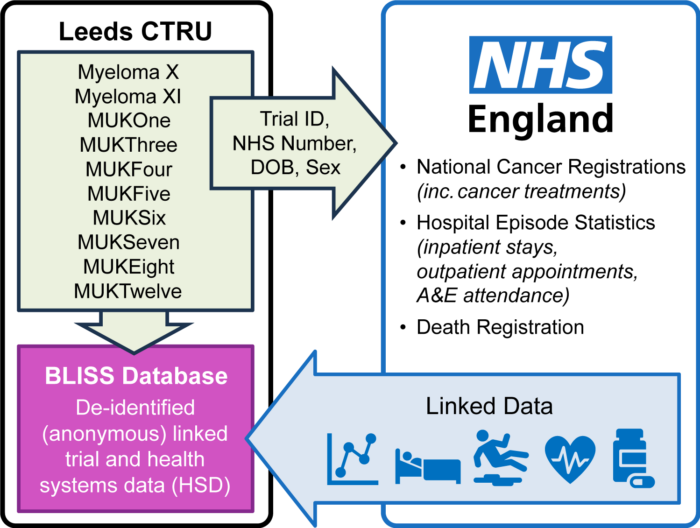
We will share the NHS Number, date of birth and sex of people who took part in the listed myeloma trials with NHS England. This will be sent securely to them.
NHS England will carry out the data linkage by exactly matching the NHS number, sex and date of birth. Linked data will then be provided to us via encrypted files.
When we receive the linked data, it will be de-identified i.e. your NHS number will be removed and will only be identified by a unique number. This data will be stored on our BLISS database and will only be accessible by the BLISS project team. This is further indicated by the diagram below:
We will only collect follow-up data from NHS England for people who took part in one of the clinical trials listed below:
| Myeloma X | MUKFive |
| Myeloma XI | MUKSix |
| MUKOne | MUKSeven |
| MUKThree | MUKEight |
| MUKFour | MUKTwelve |
If you did not take part in any of the listed trials, your data will not be included in the BLISS project.
If you withdrew from any of these trials and asked for no further data to be collected, you will not be included in the BLISS project, and your information will not be shared with NHS England.
The data we will collect includes deaths, cancer registrations, treatment and hospital admissions. This will be securely managed by the University of Leeds Clinical Trial Research Unit (CTRU) on the BLISS database. We meet all requirements to store health data in line with NHS England.
We will notify all hospitals who took part in our myeloma trials
NHS healthcare systems data is kept in a secure database and cannot be accessed freely, even if a project already has Health Research Authority approval. This data can only be released through a formal request to the Data Access Request Service (DARS). The BLISS project team has met all DARS requirements by showing that we comply with NHS England’s legal, ethical, and security standards for using data safely in research.
The BLISS project team have permission from the Health Research Authority, on the advice of the Confidentiality Advisory Group (CAG), to obtain follow-up information through NHS data linkage.
If you are interested in reading more about the CAG and their involvement in clinical trials, please access the following link: https://www.hra.nhs.uk/about-us/committees-and-services/confidentiality-advisory-group/.
No. The only data we currently hold is that which was provided by your research team at the time you registered to the clinical trial. The linked data we receive from NHS England will not contain your name, address, or anything that directly identifies you.
Your data is protected by strict data protection laws and security systems. Only approved BLISS researchers will be able to access it. We will not be sent or hold any information that identifies your name or address. Further information can be found in BLISS Privacy Notice.
Yes. You can opt-out of your data being used in the BLISS project at any time by following the instructions on the opt-out page. Once we receive your request, all data will be securely removed.
Yes. If you are a relative or carer and feel that your loved one would not have wanted to participate in the BLISS project, you can opt-out of the project on their behalf via the opt-out page.
Findings from the BLISS project will be presented at conferences and in publications. We will also publicise our results with other researchers and the wider public. We will include links to publications on this website – this can be accessed via the News/Publications’ page. You will not be identified in any results, publications or presentations.
You can contact the BLISS study team ([email protected]) if you have any concerns or questions regarding the BLISS project.